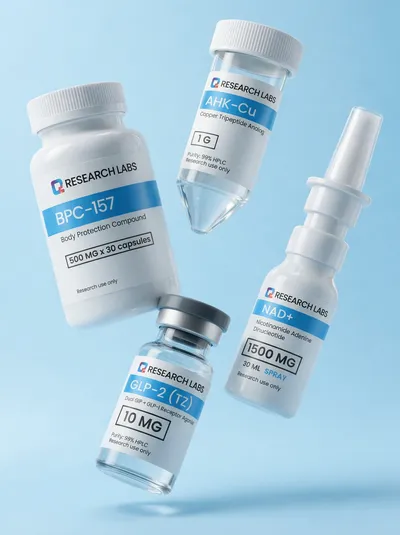
Tirzepatide acts as a dual GIP and GLP-1 receptor agonist. Semaglutide targets GLP-1 receptors alone, producing distinct in-vitro binding and signaling profiles. Research Labs supplies both GLP-2 (TZ) and GLP-1 (SG) compounds, each verified through HPLC and Mass Spec testing, enabling direct comparative receptor and efficacy studies under controlled laboratory conditions.
What Distinguishes Dual Agonists From Selective Ones?
Receptor targeting marks the core difference. Semaglutide operates as a selective GLP-1 receptor agonist, binding exclusively to the GLP-1 receptor pathway. Tirzepatide, by contrast, functions as a dual GIP GLP-1 receptor agonist, activating both the GIP and GLP-1 pathways simultaneously. This structural distinction shapes every downstream comparison in Tirzepatide vs Semaglutide research, from binding kinetics to receptor saturation curves.
Does Receptor Count Change Research Outcomes?
Clinical studies show both compounds produce significant weight loss and improved glycemic control, regardless of single or dual receptor action. The shared outcome baseline makes receptor-level data, not endpoint data, the real differentiator for in-vitro mechanisms work.
Binding assay accuracy depends on compound integrity. Research Labs maintains GMP protocols and verifies an average purity of 99.3% through HPLC. Mass Spectrometry testing on every batch. Full lab reports and certificates of analysis accompany each batch, giving researchers traceable data for distinguishing single-receptor from dual-receptor binding behavior with confidence.
How Do Efficacy And Safety Profiles Compare?
Approved indications separate Tirzepatide vs Semaglutide by age and condition rather than by raw potency. The Tirzepatide vs Semaglutide comparison, as outlined in a comprehensive provider review, shows semaglutide cleared for weight management starting at age twelve. Tirzepatide carries approval for type 2 diabetes treatment in patients as young as ten. That distinction matters for research design, since age-stratified protocols require matching the compound to its documented population.
Safety data tell a more unified story. Both molecules share overlapping gastrointestinal side effect profiles, and both carry boxed warnings tied to thyroid medullary carcinoma and MEN2 risk, according to the same provider-focused comparison. Researchers evaluating either pathway should treat these warnings as a shared baseline, not a point of differentiation.
Does Mechanism Of Action Explain The Safety Overlap?
Mechanism helps explain why side effect patterns converge despite structural differences. Semaglutide functions as a selective GLP-1 receptor agonist, activating a single receptor pathway. Tirzepatide operates as a dual GIP GLP-1 receptor agonist, engaging two metabolic receptor systems simultaneously. Studying these in-vitro mechanisms side by side clarifies why downstream gastrointestinal effects remain comparable even though receptor targeting differs.
Research Labs supports this kind of comparative work directly. The catalog lists GLP-1 and GLP-2 category research peptides within its metabolic research line, giving labs a practical basis for side-by-side mechanism studies. Every peptide shipped carries third-party testing and a published certificate of analysis for its batch. Combined with a catalog exceeding sixty premium peptides. Nationwide, reliable shipping, that documentation gives researchers a verifiable foundation for building their own efficacy and safety comparisons.
Which Peptide Source Ensures Reliable In-Vitro Results?
Research Labs ensures reliable in-vitro results through HPLC and Mass Spectrometry verification on every compound sold. This dual-testing standard matters directly for laboratories running in-vitro mechanisms studies on GIP and GLP-1 receptor activity, where contaminated or mislabeled material skews binding assays and distorts conclusions. Flawed source material costs weeks of repeated trials and compromises peer review confidence.
What Makes a Peptide Source Trustworthy for Comparative Research?
Trustworthy sourcing rests on three pillars: scientific rigor, transparency, and purity excellence. Research Labs builds its catalog around comprehensive testing protocols. Publicly available lab reports, allowing institutions to verify claims independently rather than take purity on faith.
Does Supplier Reliability Affect Reproducibility?
Reproducibility depends heavily on supplier consistency, especially when comparing a dual GIP GLP-1 receptor agonist against a selective GLP-1 receptor agonist in parallel assays. Rigorous testing and uncompromising quality standards, applied batch after batch, give research teams a stable baseline. That baseline reduces variance introduced by the material itself rather than the biology under study. For CROs and academic labs running head-to-head comparisons, that stability is the foundation reproducible data requires.
Conclusion
In closing, the comparative pharmacology and in-vitro mechanisms of tirzepatide and semaglutide underscore the critical importance of rigorous analytical characterization in peptide research. Understanding these distinct molecular pathways enables researchers to select appropriate compounds for their specific investigative objectives. Research Labs remains committed to supporting this scientific endeavor through uncompromising quality standards, comprehensive third-party verification, and transparent batch documentation that empowers researchers to conduct investigations with confidence in their compound integrity.
Get 15% Off Your First Order
Subscribe to our newsletter for exclusive deals, new stock alerts, new peptide releases, and the latest research updates.
No spam, ever. Unsubscribe anytime.